From TEMREX’s perspective, managing personal protective equipment (PPE) in an industrial environment is much more than just ensuring its availability. It is primarily a matter of control, accountability, and consistent processes that must operate across the entire organization. In many companies, traditional PPE dispensing models can no longer keep pace with the work tempo and complex facility structures, which hinders accurate consumption assessment and distribution management.
We will examine how PPE vending systems address these challenges and how they integrate into the daily operations of manufacturing plants. Based on this, we will demonstrate TEMREX’s role as a partner who has been designing and implementing solutions for years to support resource management, occupational safety, and warehouse organization.
The Importance of Vending Machines in PPE Management
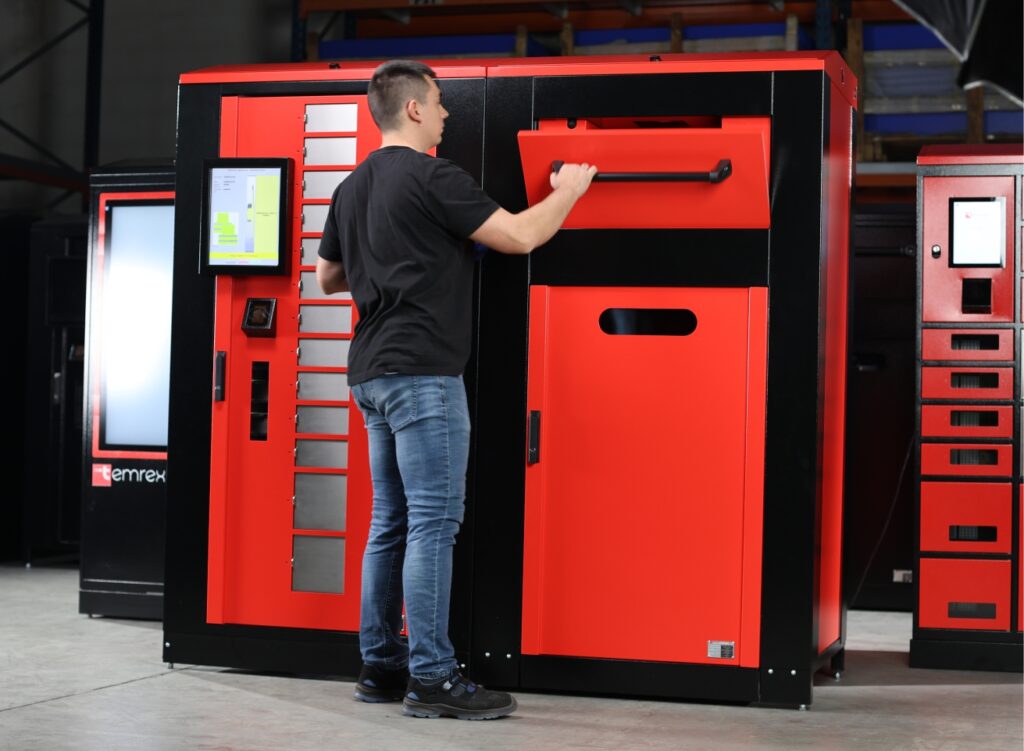
From a PPE management perspective, vending machines serve a much broader function than merely dispensing protective equipment. They are a system component that streamlines equipment distribution within an organization and establishes clear accountability rules for retrieved resources. By installing devices directly at workstations, it is possible to combine equipment availability with control over its usage, without involving additional warehousing processes.
In practice, this means transitioning from a decentralized dispensing model to a solution where distribution rules are consistent across the entire facility. Vending machines enable user identification, assignment of specific equipment types to workstations or employee groups, and real-time insight into resource utilization. This model supports OHS departments in maintaining protection standards and facilitates the enforcement of applicable procedures.
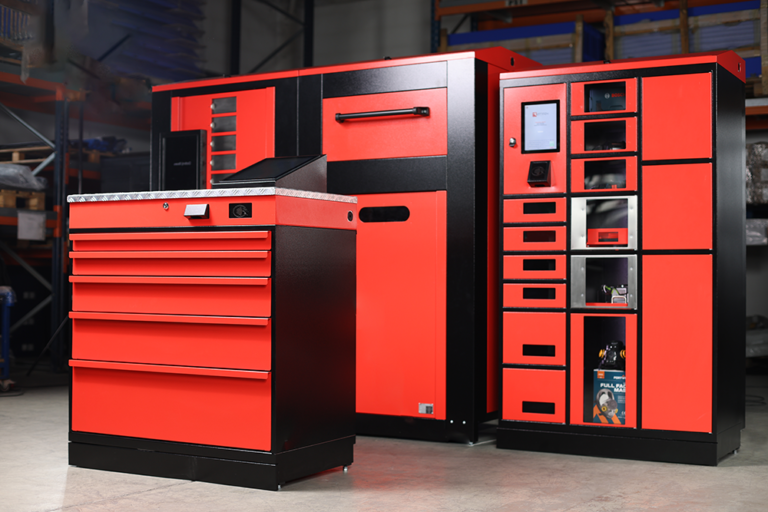
A key element of this approach is system flexibility. Depending on the type of protective equipment dispensed, its dimensions, and usage method, different types of vending machines are employed.
Selecting the appropriate solution requires an analysis of the assortment and work organization, which is why the topic of choosing a vending machine has been discussed in more detail in the article: 👉 How to Choose a PPE Vending Machine? Model Comparison: Cabinet, Drum, and Drawer
Vending machines also fit into the broader context of resource management. Connecting devices with an IT system enables data collection that supports planning, standardization, and long-term management of protective equipment in industrial facilities. In this regard, PPE vending becomes a tool for streamlining processes, not merely a technical solution.
Comparison: Traditional Operating Model vs. Vending Model
Criterion | Traditional Model | Vending Model |
Issuance Handling | Manual: warehouse staff or OHS department, issuance during working hours, often based on lists and current requests | Automatic: dispensed by device, 24/7 access, process operates at the workstation |
Consumption Control | Limited: based on paper documents or ERP entries, quick insight into current retrievals is more difficult | High: user identification and retrieval reporting allow tracking consumption over time and by individuals, departments, or positions |
Stock and Availability Management | Buffer stock and manual replenishment, often reactive after stockouts or during periodic checks | Real-time stock monitoring and needs forecasting based on retrieval data, easier to maintain continuous equipment availability |
Assortment Variety and Issuance Order | Often high variety and ‘just-in-case’ retrievals, risk of mixing types and sizes, harder to maintain a consistent standard | Better organization: consumption data helps standardize the assortment, and issuance rules facilitate maintaining compliance of types and sizes with workstation needs |
Issuance Rules and Limiting Uncontrolled Retrievals | Harder to enforce without constant control, excessive retrievals and return issues occur | Ability to set retrieval limits and authorizations, easier to maintain dispensing discipline and consistent rules for users |
Operational Workload and Repetitive Tasks | Requires warehouse operation, documentation, manual reporting, and data verification, higher risk of entry errors | The system takes over issuance registration and data generation for reports, fewer manual tasks and simpler information flow |
Support for OHS Quality | Less systematic: standard depends on consistency in dispensing and documentation | Systematic: user identification, retrieval log, and the ability to enforce issuance rules support standard maintenance |
The conclusions from the above comparison show that the vending model indirectly impacts PPE costs by streamlining issuance rules, increasing consumption transparency, and better matching the assortment to the actual needs of workstations. Controlled distribution, user identification, and access to operational data help limit uncontrolled retrievals and losses resulting from a lack of consistent processes. This mechanism is clearly visible in the example of high-turnover small PPE distribution, described in more detail in the article: 👉 TEMREX Drum Vending Machine (DYNABOX) – The Best Choice for Distributing Small PPE and Gloves.
Conditions for Effective Implementation of a PPE Vending System
Implementing a PPE vending system rarely comes down to simply placing a machine in a hall or warehouse. It is a moment when equipment issuance rules and how employees actually use it are organized. Differences between workstations, varying demand, or shift work mean that a single universal solution usually does not work. Therefore, it is crucial to first consider the actual needs of the facility.
When issuance rules are clearly defined and consistent with OHS procedures, the vending system begins to play a stable role in work organization. Equipment dispensing becomes predictable, and data access allows for a better understanding of how protective equipment is used in practice, rather than relying solely on assumptions.
The method of implementing changes also remains significant. Gradual implementation, clear communication, and logical rules ensure that the system is perceived as support for daily work, not an additional burden. In this context, PPE vending is not a one-time implementation but an element that streamlines processes in the long term.
PPE Vending System and the Approach to Sustainable Development
The PPE vending system supports more responsible resource management by streamlining the full lifecycle of workwear, protective equipment, and reusable items. Recording issuance and return moments allows for control not only over distribution but also over subsequent usage stages, such as washing, maintenance, or re-issuance.
This approach promotes reducing single-use consumption and more conscious utilization of available resources. The vending system ceases to serve solely a distribution function and becomes a tool supporting organized PPE management in an industrial environment. In practice, the vending system ceases to serve solely a distribution function and integrates into the closed-loop model in PPE, described in more detail in the article: 👉 The Role of the CYCLEBOX Return Machine in Clothing and Tool Recycling.
How Does TEMREX Support OHS Departments?
At TEMREX, we focus on ensuring that the PPE vending system is adapted to the real working conditions and operational methods of an organization, not the other way around. Our role is not limited to supplying devices but includes support at every stage of streamlining the distribution and circulation of protective equipment.
Collaboration with OHS and logistics departments specifically includes:
analysis of the method of dispensing protective equipment, workwear, and tools in a given facility, defining resource distribution and circulation rules based on workstation structure and work organization,
selection of a systemic approach and vending solution type appropriate for the assortment and scale of operations,
configuration of issuance rules, user identification, and registration of retrievals and returns,
preparation of the organization for implementation by streamlining processes and establishing clear operating rules.
Equally important is the systemic layer of support. We assist in planning and implementing IT solutions that provide real-time insight into equipment issuance, consumption, and return data, without the need for manual reporting.
Find more in the article: 👉How do reporting and vending machine limits support PPE audits?
If you are considering streamlining the distribution of PPE or want to explore how to approach the implementation of a vending system within your organization’s realities, our team can assist you during the analysis and planning stages. We support companies in establishing consistent issuance rules, adapting solutions to work structures, and preparing the system for daily operation in an industrial environment.